Hardware Requirements
RemoSIM combines a Raspberry Pi with cellular USB modems (dongles) to interface with physical SIM cards. Selecting the correct hardware—especially the USB Hub chipset—is essential for reliable 24/7 operation.
1. Hardware Checklist
| Item | Component | Specification | Estimated Price | Notes |
|---|---|---|---|---|
| 1 | Raspberry Pi | Raspberry Pi 4B (2GB, 4GB, or 8GB) | ~$45 – $75 | 4GB RAM recommended for compiling Asterisk and FreePBX. |
| 2 | Cellular Dongles | Huawei 3G/4G USB Dongles (Voice-enabled) | ~$20 – $40 each | Models with chan_dongle voice/audio & AT port support. |
| 3 | Powered USB Hub | TP-Link UH700 or UH720 (VL812 chipset) | ~$30 – $45 | Mandatory when using 2 or more dongles to prevent USB bus drops. |
| 4 | Power Supply | Official 15W USB-C Power Adapter | ~$10 – $15 | Stable 5.1V / 3.0A power prevents under-voltage throttling. |
| 5 | MicroSD Card | 32GB+ SanDisk Extreme or Samsung EVO Plus | ~$10 – $15 | High random-write performance for Asterisk CDR and logs. |
| 6 | Cooling Case | Aluminum Case or Heatsink + 5V Fan | ~$8 – $15 | Maintains low temperatures during sustained compilations and calls. |
2. Supported Cellular USB Dongles
RemoSIM relies on the open-source asterisk-chan-dongle channel driver. The dongle must support both AT modem commands and USB audio streaming (voice enabled).
Recommended Huawei Models:
- Huawei E173 / E173u (Classic, highly stable voice support)
- Huawei E1750 / E1752
- Huawei E3531 (Requires stick mode / non-HiLink firmware)
- Huawei E3131 (Voice enabled)
- Huawei K3765 / K3770
Ensure your Huawei dongle runs in Modem/Serial (Stick) mode, exposing multiple /dev/ttyUSB* ports (one for audio, one for AT data). Dongles with HiLink firmware present themselves as virtual Ethernet cards (RNDIS/web router mode) and do not support direct Asterisk voice channels unless re-flashed.
3. Powered USB Hubs & The VL812 Chipset
Cellular modems draw significant transient current spikes (up to 1.5A–2.0A) when negotiating network signals with cellular towers. The Raspberry Pi’s onboard USB bus cannot reliably power multiple cellular transmitters at once without brownouts.
Through extensive testing with multi-dongle setups, we found that USB hubs powered by the VIA VL812 chipset (found in the TP-Link UH700 and TP-Link UH720) properly handle the multi-interface USB packet timing required by Huawei modems without dropping devices off the bus.
Tested USB Hub Compatibility Matrix
| Hub Manufacturer | Model | Chipset | Multi-Dongle Compatibility |
|---|---|---|---|
| TP-Link | UH700 (v3 recommended) | VIA VL812 | Fully Compatible |
| TP-Link | UH720 (v3 recommended) | VIA VL812 | Fully Compatible |
| D-Link | DUB-1370 | Realtek | Partially Compatible (max 2 dongles) |
| D-Link | DUB-H7 | NEC / Terminus | Incompatible |
| Transcend | TS-HUB3K | Genesis Logic | Incompatible |
| Orico | MH4U-U3 | RTS5401 | Incompatible |
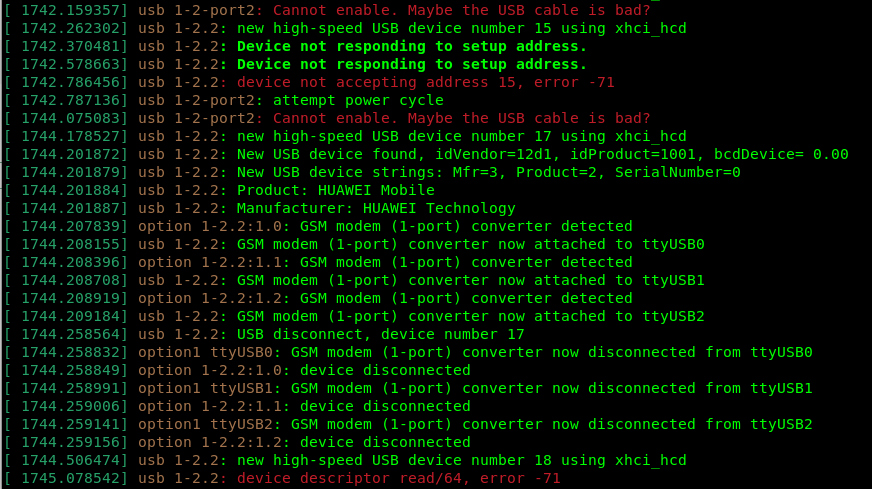
Identifying an Incompatible Hub in dmesg
When using an incompatible or under-powered USB hub, you will observe the following error codes in the system kernel log (dmesg):
usb 1-2-port2: Cannot enable. Maybe the USB cable is bad?
usb 1-2.2: device not accepting address 15, error -71
usb 1-2.2: device descriptor read/64, error -71
Next Step: Software & Server Setup
Once you have your Raspberry Pi, Huawei modems, and powered hub connected, proceed to the Software Setup Guide to install Asterisk, chan_dongle, and the Telegram SMS bot.